



Applications close in 30 days

Next cohort begins

October 6, 2026

Applications close

September 25, 2026

All cohort dates
ICF ACC pathway

Professional Certificate

The Professional Certificate in Executive Coaching builds a solid foundation that prepares you to coach senior leadership and trace recurring patterns to the root cause beneath the surface. A skill you trust under pressure. The ICF ACC credential that proves it.

Compare the ACC and PCC pathwaysSee all programs and tuition

Strategic capabilities

What you leave equipped to deploy

Professionalism and rapport open the door. Presence and pertinent insight keep you in the room as a trusted peer to senior clients.

Scope coaching engagements

Design packages for clients and three-way agreements with sponsors.

Diagnose root causes

Move past symptoms to the patterns and systemic loops catalyzing them.

Sustain trust under pressure

Maintain composure and shared safety with skeptical executives.

Deliver measurable impact

Translate insights into leadership capacity, milestones, and results.

Premium experience

How you live the program

Develop your craft within an intimate, live environment combining Master’s-level curriculum, supervised practice, senior peer exchange, and tangible commercial support.

High-yield live sessions

Maximized for real-time insights, peer coaching rounds and personal change; no passive observation.

Accelerated skill advancement

Direct, actionable feedback on your coaching conversations from certified mentors and faculty.

Trusted peer cohort

Test sharp coaching approaches inside a senior group of executives who know the stakes.

Concierge practice support

Business development coaching to help you secure high-value engagements. White-glove ICF submission review.

The cadence

Can you fit this?

Five hours of live exchange weekly and asynchronous lectures you can hear on the go. Check the specific days and times for your cohort.

2x 2.5h live sessions80% presence required

1 to 4h self-paced primingpodcasts, videos, and reflections

Example week. Your cohort’s exact days and times are confirmed at enrolment.
The priming

What powers the live practice?

A 100+ episode audio and video library delivers foundational context on demand, ensuring your live time stays focused.

Core context and conceptsDownloadable transcripts and takeaways.

Podcasts, video, articlesMobile and desktop access

Read the transcript

Coaching began outside business. The word itself came from sport. Coaches helped athletes build skill and deliver measurable performance.

In the 1980s and 1990s, pioneers such as Sir John Whitmore brought coaching into management and leadership, introducing simple frameworks like GROW that made it practical in organizations. Figures like Tony Robbins pushed coaching into the cultural mainstream.

By the mid-1990s, the International Coaching Federation was founded to set standards, publish a code of ethics, and accredit practitioners. Since then, the field has grown from a small community to more than 200,000 registered coaches worldwide.

Executive coaching has changed and is still changing. In its early years, executive coaching was mostly used to fix performance problems: a weakness to correct, a narrow goal to hit. It produced short-term gains, but proved too thin.

The tools are failing

The numbers are stark. The World Economic Forum’s most recent leadership skills report found that standard leadership development tools fail in 86% of cases.

The diagnosis is consistent across the research: these approaches treat mindset change as if it were a hard skill. The competencies that matter most are not skills. The qualities most in demand from senior leaders today, including innovative thinking, agility, resilience, trust, collaboration, and empathy, are not skills in the conventional sense. They describe how a person fundamentally is: how they read situations, how they relate, how they hold themselves under pressure.

You can map a gap on a competency model, you can assign exercises and targets, but the assumption that someone can be instructed into a different way of being is where most leadership development starts to fail. Give a leader a competency gap, map the behaviors required to close it, assign a coach to work through the logic, and most of the time, nothing fundamentally shifts.

Mindset is not a cognitive matter

What needs to shift is the mindset, and mindset is not a cognitive matter. Research in neuroscience now confirms what experienced coaches and analysts have observed for decades: mindset is embodied. It is held in the body, not only in the mind. It changes through experience and felt sense, not through instruction. This is why you cannot simply tell someone to be more resilient, or more innovative, or more present. They already know they need to be. Knowing is not the obstacle.

The gap no tool currently reaches

This points to a structural gap in how support is typically organized. On one side sits cognitive, performance-based support: frameworks, goal setting, behavioral targets. On the other sits clinical support: therapy, psychoanalysis, crisis intervention. The two rarely meet. Between them is the space where most senior leaders actually live, not in crisis, but not simply underperforming on a measurable skill either. They are navigating identity, interpretation, and the meaning they make of their experience. That is where mindsets change, and it is where most available tools do not reach.

The most effective coaches have always worked in that space, often intuitively. The McKinsey State of Organizations report, published in 2026, names it directly as one of the defining leadership challenges of this moment: reinventing leadership from the inside. The challenge, as they note, is that knowing it matters and knowing how to do it are very different things.

The coach needs to go first

There is one further dimension that shapes how this kind of development actually works. To grow into a genuinely different way of seeing, a person needs a reference point, someone who has already been to that place. This is not metaphorical. Analytical psychology calls it transference. The coach who has not done their own interior work cannot hold the space for a client to do theirs. A coach operating from a narrow or defended place becomes an obstacle, not a support.

The coach needs to go first.

This is the founding principle of the Claristrat method, and why the program is structured the way you will experience it.

The toolkit

What stays on your desk?

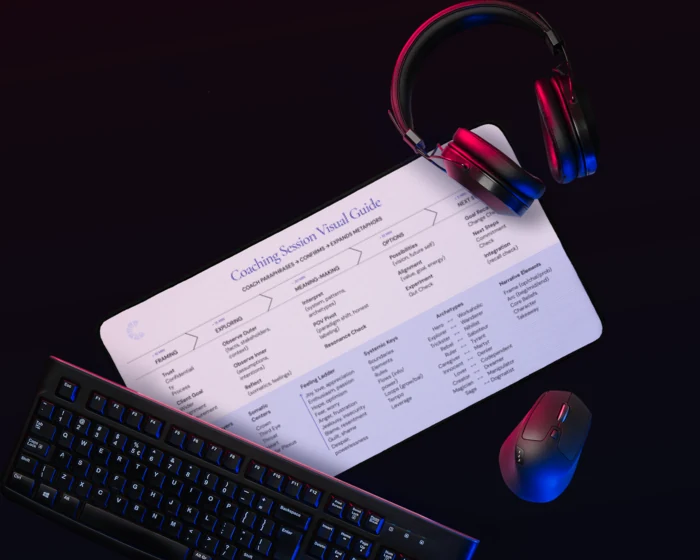
Tactile CompanionsPremium deskpads with engagement and session flows for real-time reference

Practice AssetsBio templates, contracting checklists, assessment guides, rate benchmarks, session decoders, and more

Download a sample template

Enter your email and the PDF downloads straight away.

Your address goes to the admissions team, who may follow up about the program.

A Claristrat desk mat printed with the Coaching Session Visual Guide, shown on a desk with a keyboard, mouse and headphones.
Systemic curriculum

The architecture of high-stakes coaching

Twelve weeks mapped directly to how senior engagements evolve, from presenting and scoping the work to lasting leadership change.

Arc I · Intentional Awareness · Weeks 1–4

Module 1 Foundations of Professional Coaching

What You Master
The ethical and structural backbone of practice: clarity of agreements, psychological safety, disciplined presence, and session architecture aligned with ICF competencies.
Executive Value
Establishes the institutional standard required to secure and honor senior executive trust.

Module 2 Expanding Awareness

What You Master
Listening beyond content to emotion, pattern, assumption, tempo, and bias. Developing interpretive discipline without defaulting to boxed judging.
Executive Value
Pinpoints what senior leaders cannot put into words, unlocking the unsaid friction underneath.

Arc II · Dynamic Meaning · Weeks 5–8

Module 3 Systemic Meaning-Making

What You Master
Identifying loops, leverage points, and self-fulfilling narratives across emotional, relational, and organizational layers.
Executive Value
Equips you to resolve root causes rather than symptoms so systemic issues stop recurring.

Module 4 Directional Coherence

What You Master
Facilitating semantic reframing and clarifying a client’s North Star as an embodied orientation. Grounded, disciplined visioning.
Executive Value
Helps clients set a strategic direction that holds cleanly under organizational turbulence.

Arc III · Iterative Transformation · Weeks 9–12

Module 5 Operational Pathfinding

What You Master
Detecting coherence gaps between aspirational values and daily operating behaviors. Designing forward movement that holds under real-world pressure.
Executive Value
Translates deep psychological insight into measurable behavior change that strengthens client self-reliance.

Module 6 Organizational Application

What You Master
Multi-stakeholder contracting, ethical assessment integration, and practice foundations: proposals, positioning, and engagement design.
Executive Value
Bridges coaching mastery with commercial execution, giving you the exact playbook to win, contract, and deliver senior-level mandates.

From a graduate

I can’t begin to express how valuable this development was. I wish I had done this as a younger leader. Even if you don’t want to be a coach, if you manage people, lead organizations, boards or teams, these skills are invaluable.

Arthur FleischmannFormer Group CEO, john st. & Ogilvy Canada · Country Lead, WPP Canada · CEO, Sense.Maker
Read more from our graduates
Aggregated details

Full ACC pathway specifications

Every operational, academic, and financial item consolidated for your final review.

Cadence & Time Commitment

DimensionRequirementExecutive Context
Live Duration60 hours over 12 weeksTwo 2.5-hour sessions weekly
Priming40 hours, asynchronous1-4 asynchronous hours weekly
Mentoring10 hours7 group sessions and 3 private · ICF-certified mentor
Total Duration110 hours60h live · 40h asynchronous · 10h mentoring
Presence80% attendanceICF requirement for certification · Recorded sessions available
Delivery ModelFully onlineLive sessions with asynchronous priming

Additional Program Deliverables & IP

Included AssetDeliverableStrategic Value
One-on-one Executive Coaching for learners4 private 60-minute sessionsExperience the Claristrat methodology firsthand from the client seat, supporting your journey
Hogan Leadership ProfileFull HPS, MVPI, and HDS assessments and debrief with your certified Hogan coachUncover your personal leadership edge, core motivators, and operational blind spots
Coaching Feedback5 observed sessionsDetailed written feedback on your evolving coaching style, mapped to both ACC and PCC ICF markers
Practice AssetsBio templates, contracting checklists, assessment guides, rate benchmarks, session decoders, and moreClient-ready commercial and operational materials for your credentialed practice
Tactile CompanionsPremium deskpads with engagement and session flowsDesigned for easy real-time reference before, during, and after sessions
Business SupportBlue-chip sales coachingStrategic guidance to package, price, and land high-value clients
Methodology LicenseIntellectual property rightsIndividual practice rights to the Claristrat Method and frameworks

Certificate & Credential Pathway

Credential ThresholdClaristrat DeliversICF ACC Requirement
Program CertificateProfessional Certificate in Executive CoachingOfficial Level 1 Accredited Education ProviderMeets requirement
Educational Hours100 coach-specific hours60h live + 40h asynchronous, excluding mentoringExceeds 60h requirement
Mentor Coaching7 hours group and 3 hours one-on-one with a certified mentor coachMeets requirement
Client Coaching LogPractice tools, rate benchmarks, and sales guidance to help you build the log100+ client hours logged (75+ paid) after your program startsYours to complete. Our support goes beyond what is required of a training provider.
Final SubmissionWhite-glove ICF submission reviewPay the credentialing application fee, submit your Claristrat Level 1 certificate and coaching log, and pass the online ACC examYours to complete. Our support goes beyond what is required of a training provider.

Investment & Cohort Placement

Financial OptionDetailsNotes
Full Tuition$8,000 USDPayment with application
Installment Plan5 × $1,600 USDMonthly payment schedule
Next CohortStart on October 6, 2026Apply by September 25, 2026See all upcoming cohorts
Pathway ExpansionPCC upgrade priorityFull tuition credit toward the Advanced Certificate. Terms apply.

Your seat is held while faculty reviews the fit. If the cohort is not right for you, we refund in full.

Common questions

Before you reserve a seat

Does the Professional Certificate make me an ICF ACC?

No. Your certificate documents the education, mentor coaching, and performance evaluation components of the Level 1 path. You still complete the ICF’s experience, application, and exam requirements; the ICF reviews the application and separately awards the ACC.

Can I complete the program while working full time?

The 12-week core is designed for working senior leaders: five scheduled live hours and about three to four self-paced hours in a typical week. Mentor coaching follows the live core.

When does mentor coaching happen?

After the 12-week live core. The current program model includes ten mentor-coaching hours across seven one-hour group sessions and three one-hour individual sessions.

Can my organization sponsor my tuition?

Yes. Corporate sponsorship is supported, and the admissions team can provide the documentation your organization needs.

What happens if the faculty conversation shows it is not a fit?

Your seat is held while faculty reviews the fit. If the cohort is not right for you, we refund in full.

Can I move from the ACC pathway to the PCC pathway?

Yes. You share the first 12 weeks with the Advanced cohort and can decide by week 12 whether to continue.

Next cohort · October 6, 2026

Ready to learn how to change what a leader can see?

  • 12-week live core · mentor coaching follows
  • Applications close September 25, 2026