Advice for what can be solved.
Risk analysis, best practices, expertise, technical development, and performance plans.
A proprietary framework for senior leaders, coaches, and teams.
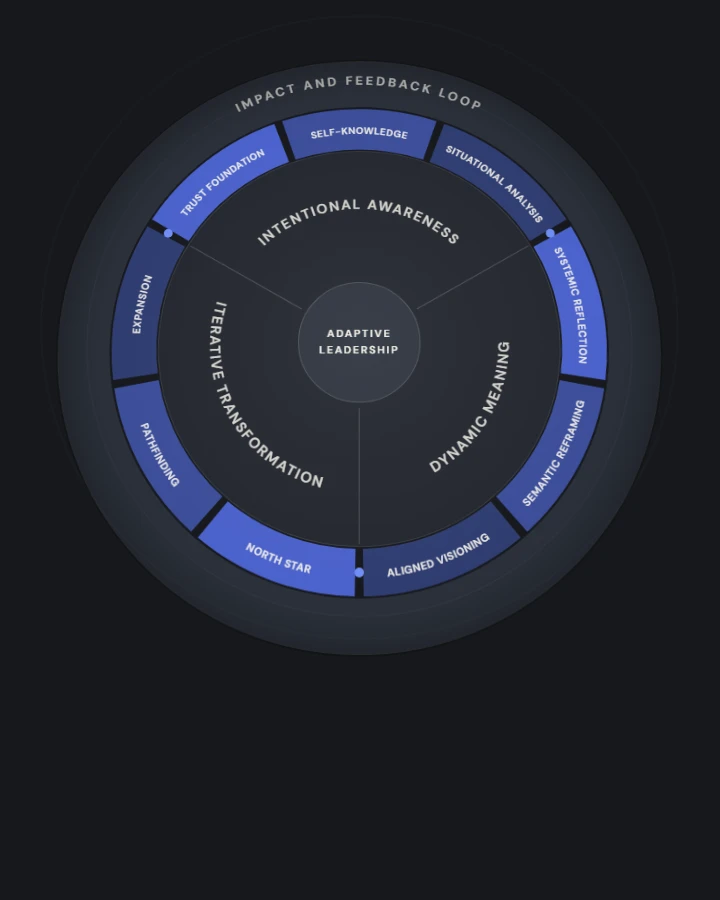
It treats the leader and the surrounding organization as one interacting field, then moves through three ordered arcs: see the field clearly, change the meaning that organizes it, act in a way that holds.
Senior leaders rarely lack analysis, advice, or information. The real challenge is seeing how they and the system shape one another, staying with uncertainty long enough for a different reading to emerge, then acting without forcing a premature resolution.
Claristrat occupies the developmental territory between cognitive support and clinical care. It is coaching, with a clear professional boundary around both.
Risk analysis, best practices, expertise, technical development, and performance plans.
Meaning, identity, role, relationships, power, uncertainty, and the system surrounding the leader.
Diagnosis, crisis response, therapeutic intervention, and clinical formulation by qualified professionals.
Claristrat operates at depth without crossing into diagnosis or treatment. The client is held as whole, capable, and the author of their own development.
The developmental middle
Cognitive support on one side. Clinical support on the other. Between them sits a wide territory with no register of its own, where leaders' developmental needs live.
The sequence
The order is load-bearing. Each arc supplies what the next one needs.
The movement
The arcs are not walked once. Each pass works the same structure at a deeper register.
The complete system
Beneath the wheel sits the rest of the method — nine phases, each opening into finer work. Certification goes down there. This page does not.
The arc names become useful when you can see the handoff between them. This composite example follows the same challenge from the leader’s first account to a testable change in the system.
The coach establishes trust, maps the leader’s patterns, and widens the view to stakeholders, governance, power, history, and the pressures surrounding the role.
“My team cannot make a decision without me.”
Instead of correcting the team, the coach maps the leader’s identity as the indispensable expert and the organizational conditions that keep returning authority to them.
The coach reads the recurring system pattern, stays with the moment when the old account loses certainty, and lets a new orientation form from the leader’s own values.
An identity transition.
The challenge is no longer “How do I make them step up?” It becomes “What must I stop organizing around me so leadership can move through the team?”
The leader names the organizing direction, configures the next move, observes what the system returns, and integrates the learning into the next pass.
Enter the next decision as the sponsor.
The leader changes one live meeting, watches where authority travels, repairs what pulls it back, and uses that evidence to design the next move.
Arc 1 of 3
The Method distinguishes the developmental architecture from the way a coach listens in real time. One keeps the structure coherent. The other lets the conversation follow the client without becoming mechanical.
The coach holds four movements in view while following what is alive. They recur, overlap, and deepen rather than unfolding as a fixed script.
Select a movement to trace it on the diagram.
Each lineage addresses a distinct challenge. Together they help the coach read the system, understand meaning-making, navigate interior dynamics, and support learning under pressure.
Read behavior together with identity, meaning, relationships, power, and the system that keeps a pattern returning.
Stay with not-knowing, distinguish when to observe from when to move, and treat timing as part of the intervention.
Ground presence in lived developmental practice, not in the performance of certainty or a technique applied from outside.
How to read the leader and organization as one interacting system, including patterns, constraints, emergence, and the timing of change.
Snowden and Cynefin lineageHow a leader’s meaning-making frame develops, what they can hold under load, and how a wider frame becomes possible without skipping stages.
Kegan lineageHow identity, symbol, shadow, charged patterns, and the tension between old and emerging configurations shape what a leader can perceive.
Jung, Stein, and Edinger lineagesHow regulation, attunement, relationship, and embodied signals contribute to a leader’s capacity to stay present with complexity.
Neuroscience and somatic lineagesThese are methodological influences, not claims of endorsement by the named scholars or frameworks. Full citations belong in the methodology overview and bibliography.
The Method engages the present leadership context and treats the client as whole and capable. Clinical care remains with clinicians.
No disorder is named and no clinical formulation is applied.
The client is not a problem to repair. They retain agency and authorship.
The process does not search the past for clinical material or attempt treatment.
Signs of instability stop the coaching engagement and move to the appropriate professional.
“You cannot take a client where you have not been willing to go yourself first.”
The developmental cycle is lived, not only studied. Before practitioners hold the arcs for a client, they move through the progression themselves, with real stakes, inside a cohort designed as part of the learning instrument.
Senior leaders develop the Method through Claristrat’s Professional and Advanced certificate pathways.
Thematic sessions, retreats, and bootcamps let leaders encounter the Method live before committing to a longer engagement.
At organizational scale, Complex Systems Leadership Development™ brings one shared architecture to engagements, supervised coaching benches, and internal programs.
For readers who want a direct definition before the full paper.
A proprietary executive and team coaching methodology that engages the leader and the organizational system as one interacting field.
The Method’s developmental architecture: three ordered arcs, nine phases, and twenty-seven practical elements.
The arcs are revisited as a leader encounters new situations. Each pass works at a deeper register rather than repeating a checklist.
No. It does not diagnose, treat disorders, or excavate trauma. Clinical concerns and crises are referred to appropriate professionals.
Through coach education, live experiences, individual and team engagements, supervised coaching benches, and internal organizational programs.
Both papers are the source material behind this page: the argument at full length, and the shelf it was built from. No form, no email required.