The Psyche as a Complex System: What Jung Knew That Complexity Theory Is Still Learning
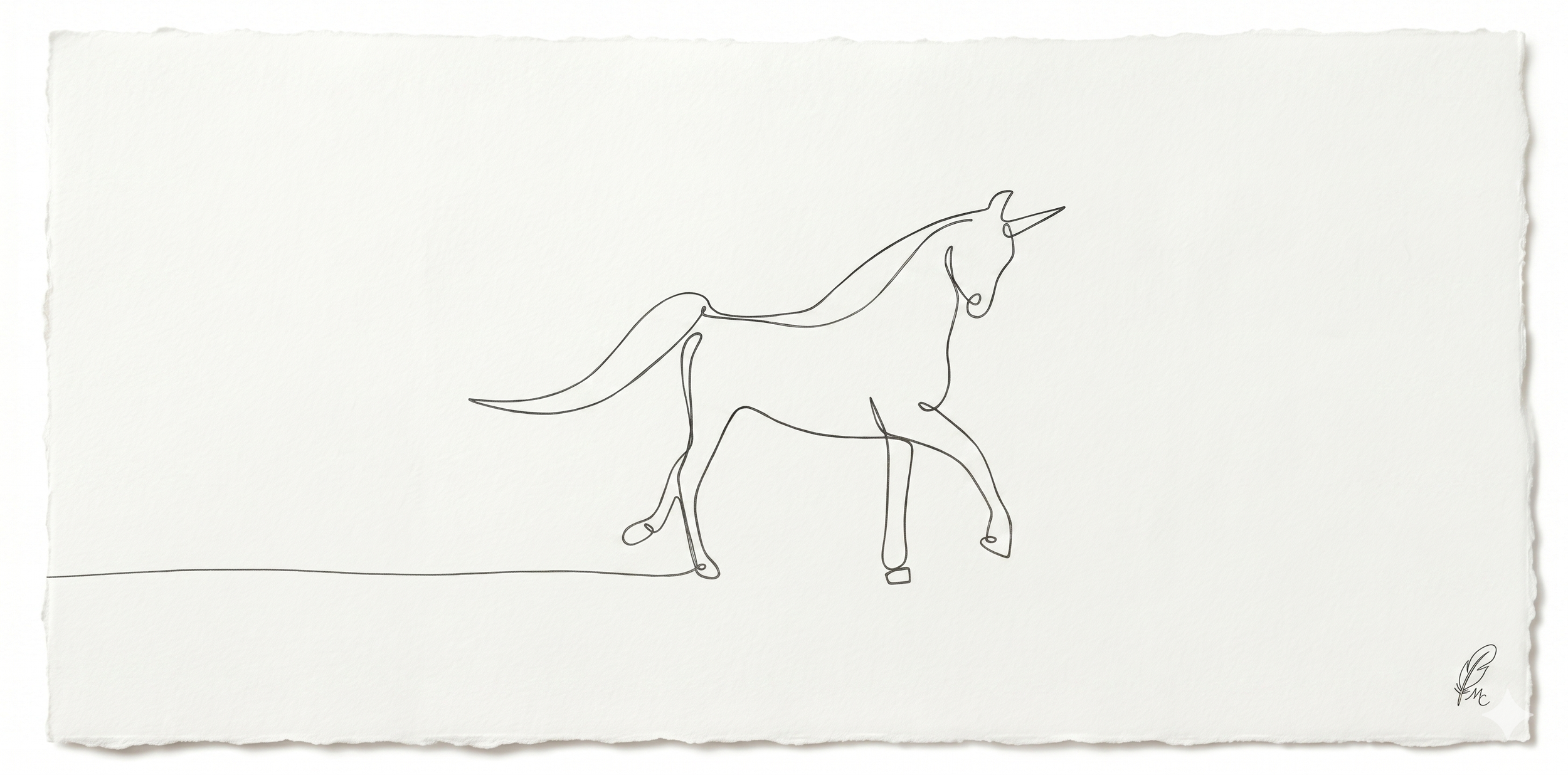
Unlike this one, my daughters’ imaginal unicorns are rainbow-colored and have large bird-like wings.
My three-year-old and my five-year-old see unicorns.
When I ask where, they say: right here, in the imagination. Because I taught them that the imagination is the part of reality in which everything is the way we create. I shared this concept with them, in this particular way, very consciously. I wanted to keep something alive in my daughters that most development, in the Western tradition, requires children to abandon as the price of rationality: the capacity to inhabit a register of experience that is neither physical nor purely invented, where image and meaning and interior experience have real weight, where the world is still in relationship with everything in it.
This is what participation mystique names. Carl Jung adopted the term and spent a career mapping it. What he understood, and what most developmental theory has not yet absorbed, is that this capacity is not a stage to be left behind. It is where development starts, and, if it goes where it can go, where development returns. Three thinkers, in three disciplines, across three centuries of emphasis, found the same thing. That is where this article begins.
Three independent maps. One territory.
Lévy-Bruhl, Jung, and Kegan converged on the same developmental sequence from three independent directions. Their instruments were different. The territory was the same. Let’s start the exploration with how Lucien Lévy-Bruhl, in How Natives Think, 1910, p. 61, described participation mystique:
““In the collective representations of primitive mentality, objects can be something other than themselves... they give forth and they receive mystic powers, virtues, qualities, influences which make themselves felt outside, without ceasing to remain where they are.””
You will note that it is not positioned as cognitive deficit. It is rather a state in which no boundary between subject and object has formed, because no ego exists yet to draw one. The field is present. Experience is present. This is not the self dissolving into the world either. It is the world before the center of consciousness has fully crystallized. Jung adopted the term and defined it clinically.
““PARTICIPATION MYSTIQUE... consists in the fact that the subject cannot clearly distinguish himself from the object but is bound to it by a direct relationship which amounts to partial identity.””
Jung expanded the application of the concept beyond pre-modern cultures. He identified it as the foundational condition of all human consciousness:
““A relic of the original non-differentiation of subject and object... It is also a characteristic of the mental state of early infancy, and, finally, of the unconscious of the civilized adult.””
Robert Kegan, working half a century later without Jung as his source, arrived at a similar view of this trajectory, of what I will call here the civilized mind, through a third instrument: the longitudinal subject-object interview, tracking how adults reorganize meaning across a lifespan.
Three instruments. Ethnographic observation, clinical measurement, longitudinal interview. Now concede what the skeptic raises first, because it is correct. These three did not work in sealed rooms. Jung read the anthropology of his day. Kegan inherited a Western developmental tradition steeped in the same story. Agreement among people who share a worldview is weak evidence. It can be the worldview talking.
So the agreement is worth nothing where the shared inheritance could have supplied it, and worth attention only where it could not. A culturally inherited progress myth predicts a universal ladder: everyone climbs, higher is better, the endpoint is fixed and the same for all. The sequence these three describe predicts the reverse. It runs only under specific civilizational conditions. Where the conditions are absent the sequence does not run, and its absence is not deficiency. That is the progress myth’s refutation, arrived at three times from three directions. A shared bias does not generate the boundary condition that dismantles the bias. The convergence that counts is the one that survives subtracting everything the three had in common.
What it points toward is a claim this article will make directly. The psyche admits the same description we give any complex system, with one difference that should interest complexity science more than it has. It is the only complex system any of us observes from the inside. Every other one we model from outside its boundary. This one we inhabit. The frameworks built to read organizational complexity from outside are working without the one interior vantage available, and they are working without it by choice.
The state space of a complex.
A fair challenge, and the one a complexity scientist raises first: attractor is a formal term. It names a region in a state space, with dimensions and dynamics on them. Use it without specifying those and you are decorating, not modeling. The challenge is productive, so let’s specify them unambiguously.
Naming the state-space.
Jung built the instrument in 1904. The Word Association Test measured three things across a series of stimulus words: reaction-time latency, autonomic arousal through the electrodermal response, and failure to recall the original answer. What he found was clustering: spikes in latency and arousal that gathered around thematically linked contents, independent of, and often contradicting, what the subject reported feeling. He had located something that organized response, ran on its own charge, and disrupted processing on contact. He called it a complex.
Naming the dimensions.
Activation: how online the complex is at a given moment, read through latency, electrodermal response, heart-rate variability, vocal prosody, the micro-hesitation. Porges supplies the framework for the autonomic layer. Charge: the intensity and sign of the affect bound to it. Semantic basin: the set of contents, words, situations, people, role-demands, that pull the system into it. Ego-coupling: whether the ego is run by the complex or can hold it as object, operationalized as the gap between what a person enacts under activation and what they can observe when they are not. That gap narrows as the complex moves from subject to object. The narrowing is the Kegan dimension, and it is in principle measurable.
Naming the dynamics.
The complex is an attractor in the exact sense: a configuration the system reliably falls into when the basin conditions are met, and returns to under perturbation. The triggering conditions are the basin boundary. Power activating the parental complex is a field condition dropping the system into a basin. Once in, return to baseline is slow, which is hysteresis, which is path dependency in dynamical terms.
The semantic-drift window earns its keep here. When the dominant attractor’s basin flattens, the system sits near a transition, maximally sensitive to small inputs. Systems approaching a transition emit a known signature: recovery from perturbation slows, variance rises. The behavioral correlate is exact. The normally fluent client begins to stumble, repeat, lose the thread. That rising variance is not noise to be smoothed. It is the early-warning signal of an approaching reorganization, and it tells the coach the window is open.
Now the honest limit: there are no closed-form equations here.
But a phase space is identified state variables plus dynamics on them. It is not a set of equations. Epidemiology, population ecology, and meteorology each had working phase spaces, and made real predictions, before any had tractable equations. The complex has had identified state variables and a measurable signature since 1904. Unformalized is not unspecifiable.
And the falsification conditions, since a model that cannot fail is not a model. If thematically clustered stimuli produced no correlated deflection in latency and arousal, the construct would be wrong. If ego-coupling were uniform across a person’s domains rather than varying complex by complex, the central claim of this article would be wrong. If transitions arrived with no rising-variance precursor, the semantic-drift window would be a fiction. None of these has held up that way. Each could.
This is an epistemological claim, not a metaphysical one. I am not asserting that the psyche is, in the furniture of the universe, a dynamical system. I am asserting that it admits that description, that the description has named variables and measurable dynamics, and that it makes predictions which can fail. That is the standard. The model meets it.
The point where the work meets physics.
One thing the 1904 instrument does not let us pretend. The coachee’s activation is, in principle, measurable, and that is how it was first measured: latency, arousal, the failure of recall. But the ego is itself an observer, and inside the psyche observation is not a neutral read. When attention falls on a complex, the complex moves. In the coaching container this is an observable fact and not a conjecture: name the pattern a leader is sitting inside, bring it into the light of attention, and it shifts in the room, in real time. The act of seeing it is already an act upon it.
What that act does to the complex over the longer arc, whether attention durably reorganizes the structure or only surfaces it, is far less observable, and I will not pretend otherwise. That is an open question, and an interesting one, closer to metaphysics than to measurement. I hold it as a live speculation, not a finding.
I want to be precise about why we are evoking physics, because the connection is routinely abused in support of intellectual arguments across the field and I am not surreptitiously borrowing the authority of quantum mechanics to dignify a psychological claim. The lineage runs the other way, and it is documented.
From the beginning of his career, during Einstein’s Zurich years, Jung was set thinking, by Einstein himself, about a relativity of time as well as space and its psychic conditionality. By his own account, that spacetime insight was the seed of synchronicity. More than thirty years later the same line of thought led to his long collaboration with Wolfgang Pauli, a Nobel physicist, and to the formulation of synchronicity in full.
The observer-as-participant was built into these concepts at their origin, through that contact, and not grafted on afterward. A man who carries an idea for half a century before he publishes it, and reaches for a Nobel laureate to help him formalize it, is not running on loose association. I raise the lineage not to make the argument sound solid, but because it requires the fidelity, and because the reader should see the actual intellectual ground of what is being claimed: the observer sits inside the system observed, and the thinker who drew this interior map understood this requirement as a feature of the territory.
The psyche as a system of complex-attractors.
Most developmental theory and most complexity theory share an unexamined premise: the individual is a unified subject with centered agency. Jung dismantled it a century ago.
The psyche is not a unified system with a single center. It is a field populated by multiple complex-attractors: clusters of emotionally charged material, each organized around a symbolic role, each operating with autonomy from the others. The authority complex, the approval complex, the caregiver complex. These are not metaphors. They are functional nodes that organize psychosomatic energy, generate behavior, and shape perception regardless of, and often against, the person’s preferences.
The Self is simultaneously the largest of these attractors and the field within which the others operate. In Jung’s definition:
““Not only the centre, but also the whole circumference which embraces both conscious and unconscious.” ”
The Self does not direct. It contains. The complexes are autonomous. The shadow runs independently of conscious intention. The transcendent function generates configurations the ego did not specify.
The ego is one attractor among them, distinguished by a single property: it is the node that can become conscious of the others. It can, under the right conditions, stand outside any other complex and observe it. That capacity for reflexive observation is the direction of development, though not its destination: the system progressively expanding what it can hold as object.
But the ego does not begin with that capacity. Jung described the earliest phase as anarchic: islands of consciousness in a chaotic field, no stable center. The ego crystallizes out of it into what he called the monarchic stage. Before that, there is no ego. There is the field. There is participation mystique. The ego is not dissolved in it. The ego has not yet arrived.
The ego-Self axis: the engine of development.
Edward Edinger, in Ego and Archetype (1972), mapped what happens next, and Kegan arrived at the same structure half a century later by empirical observation.
Development is the progressive differentiation of the ego-attractor from the Self-as-field, followed, ideally, by a conscious relationship between the two. The ego begins embedded in the Self. It must separate to become a center of consciousness. But maximum separation is not the goal. Conscious relationship is: an ego strong enough to stand in relation to the Self rather than be dissolved in it or defended against it. This axis is the engine of every developmental stage.
The pre-ego configuration is participation mystique. The Self as field. No differentiated attractor yet capable of holding anything as object. This is the substrate from which everything else grows, and the work of development, the kind that produces leaders who can read the field they are inside and coaches who can reach the depth at which change occurs, is the capacity to return to it consciously, without being dissolved by it.
The ego-dominated configuration is Kegan’s Imperial Mind. The ego has crystallized but cannot yet stand in relation to the other complexes. They run through it. The drives, the archetypal constellations, the instinctual imperatives are not yet the ego’s own. The ego has arrived and is in charge of nothing, least of all itself.
The projected-Self configuration is Kegan’s Socialized Mind. The ego has separated from the immediate relational field but cannot locate its center internally. It projects the Self outward, onto authorities: God, the institution, the idealized leader. The socialized person is not weak. They are organized around an external Self-proxy that gives coherence and direction. The problem is that the organizing center is outside, which means it can be withdrawn, can change, can betray. The ego has outsourced the Self.
The internalized-Self configuration is Kegan’s Self-Authoring Mind. The ego withdraws the projection and locates the reference point within. This is the beginning of interiority. But the Self in its totality remains largely unconscious. The shadow complexes, the deeper configurations, still run below observation, shaping the framework without its knowledge. The ego manages the known territory while the unknown territory manages it from behind.
The Self-as-field configuration is Kegan’s Self-Transforming Mind. The ego has separated enough from its own framework to hold it as object. The pull of the Self toward integration becomes available. The ego works across multiple systems without needing any of them to be definitively correct, because its stability no longer depends on any one framework being right.
The permeable-boundary configuration is what Jung approached late: the unus mundus (Tao, in the Eastern tradition, or Adonai echad in the Judeo tradition). The boundary between ego and Self becomes permeable in both directions. The ego does not dissolve. It becomes a conscious participant in the dynamic that always contained it. This is where my children already live, in the imagination, the part of reality in which everything is the way we create. The developmental work is to find the way back to that address without losing everything we built on the way out.
Different conditions, different demands.
Two claims have to be held apart, because a careless reading collapses them and a hostile one exploits the collapse. The first is about order: the configurations come in a fixed sequence, because each builds the substrate the next requires. You cannot withdraw a projection you have not made. That ordering is structural, and it is what makes the ego-Self axis the engine of the sequence. The second is about worth: whether a person is pushed along the sequence, how far, and whether being further along counts as more developed. That is not structural. It is ecological, set by the conditions a life is lived under. Order is fixed. Value is conditional. The sequence has rungs that come in a necessary order and no inherent up.
Murray Stein, in Jung’s Map of the Soul, locates the pressure toward individuation not in Western culture but in civilizational complexity as such. Any society that becomes large, hierarchical, and divided by labor generates individuating pressure. Division of labor creates roles. Roles create gaps between what a person is and what the role requires. Hierarchy creates power differentials that require concealment. Scale creates anonymity in which the collective can no longer hold the individual in full. These are not Western inventions. They appear in ancient China, in the Indian caste system, in the Ottoman court, in any civilization past the threshold of sufficient complexity.
Where a society is small and organized around shared cosmological meaning, the ego still forms. Wherever there is an individual name there is a center that can say “I.” What does not happen is the overdevelopment. The ego is not driven to the hypertrophy the civilized ego undergoes to meet role, hierarchy, and concealment, because those demands are not present. In Jungian terms the ego-Self axis, the channel through which symbolic material from the unconscious reaches the ego, stays open. It is not blocked the way the civilized axis is blocked.
The image is a clogged tube, not a cut one: in high-complexity conditions the channel is mostly closed off, so the contents it would carry are held back, repressed, and what is repressed is what becomes the shadow. Where the conditions do not demand that closing, little is held back. The shadow is small. Not absent, but small, and not prominent, because there is no gap forcing material out of awareness. It is not split off. It is lived. The persona, the defended surface that conceals what the collective will not accept, is unnecessary for the same reason. Where nothing needs to be hidden, nothing needs to be hidden.
The small shadow and the undeveloped overgrowth have one cause. The cosmologically embedded ego was never required to close the channel, so it never accumulated the repressed material the civilized ego carries, and never had to spend a lifetime recovering access to it. This is why the first and last configurations rhyme. The permeability of participation mystique, before the ego forms, and the permeability of the unus mundus, after the ego forms and differentiates across a lifetime, are the same openness reached two ways.
The civilized arc is the long road: close the channel at great energetic cost, overdevelop, then work to reopen what was closed. The cosmologically embedded ego is on the shorter arc because it never closed. The individuated person who reached self-authorship at the cost of cosmological connection is not more developed in any absolute sense. They built the capacity their conditions demanded, and paid for it in the coin those conditions charged.
This is not cultural relativism. It is ecological precision.
The configurations accumulate.
The most important correction to how stages are usually understood: when a new order of mind becomes available in one domain, the earlier configurations do not disappear. They stay operative wherever the relevant complexes have not yet differentiated. Development is not a sequence of rooms you walk through and close behind you. It is a layered architecture that accumulates across the complex centers of the psyche at once.
My three-year-old in participation mystique and my five-year-old negotiating rules are not at different stages in any simple sense. They are at different stages in different domains, the earlier configuration alive alongside the new. The permeable-boundary and pre-ego configurations coexist without contradiction, each in its own domain.
The same holds in adults, at higher stakes. A senior leader who authors themselves with precision in strategic decisions may be entirely authored by the approval complex in front of the board. Power imbalances are among the most reliable activators of projected-Self dynamics in otherwise self-authoring adults. The board, the investor, the founder whose approval determines survival: these activate the parental complex with its full archaic charge. The regression is not pathological. It is structural. The psyche matches the current field condition to the configuration that historically navigated it.
So you cannot assess a person’s developmental stage. You can assess the configuration of a specific ego-complex relationship in a specific activated context. And the coaching work is not moving someone from one stage to another. It is widening the range of contexts in which the more differentiated configurations are available, and reducing the automatic activation of the less differentiated ones where they currently dominate.
Path dependency here works like ecological succession: pioneer species alter the substrate, making certain later configurations possible without specifying which will stabilize. The birch forest does not develop toward beech woodland. It creates conditions under which beech woodland becomes available. Kegan’s sequence works by the same mechanism. The projected-Self configuration does not develop toward the internalized-Self configuration. It builds the substrate, through accumulated relational complexity and the pressure of self-authorship, under which the internalized-Self configuration becomes available. The transition is not prescribed. It is made possible by what came before.
And the same logic runs down to the cellular level. Each synaptic change alters the substrate so that certain subsequent changes become available that were not before. That is ecological succession at the level of neural architecture. Whether it is also the same mechanism as Kegan’s subject-object shift, or a structural rhyme across scales, is not settled, and I will not claim the stronger version on evidence that supports only the weaker. The weaker version is enough: substrate altering substrate appears at the neural scale, the developmental scale, and the individuation scale alike, and a framework that can hold all three is accounting for more than one that holds only the middle.
Development and emergence are not alternative logics. At their most productive they are two ways of describing one process. Individuation is not a destination. It is the ongoing project of bringing more of the system into conscious relationship with itself, complex by complex, domain by domain, across a lifetime.
Semantic drift: the transition in complexity terms.
There is a moment in every developmental transition, and in every real organizational change, when the old attractor has lost its pull and the new one has not formed. Kegan calls it the transition between orders of mind: what was subject is loosening but has not yet become object. Complexity theory calls it semantic drift.
From the inside it feels like this. I don’t know where to put my meaning. I don’t know who to go to. I don’t know what is valuable. The reference points no longer hold. Most coaching frameworks treat this as a problem to resolve quickly.
It is the window. Maximum instability is maximum leverage. The old attractor has lost gravity, the capital is not yet reconstituted, and a different organization of meaning becomes available as a lived reorientation rather than an intellectual insight. The coaching implication is exact: timing matters more than force. You will not stronghold a client toward lasting change even if you are the best coach alive. You can help them stay in the drift long enough for the new configuration to consolidate. That requires the coach to tolerate the instability. The coach who reaches for premature closure because the looseness is uncomfortable has missed the moment.
The organizational implication is the same. Crisis and transition are not problems to manage around. They are the conditions under which field-level change becomes possible. Organizations that use inflection points, post-acquisition integration, succession at scale, AI-driven operating-model redesign, as developmental containers rather than emergencies to stabilize come out of the transition with something substantively different. The ones that stabilize too fast return to a version of the previous attractor with better branding.
What this means in practice.
For the coach in the room:
The client in front of you is not a unified subject with a developmental level. They are a complex system with multiple activated configurations, each at a different degree of ego-Self differentiation, each requiring different attention. Mind the conflicting loyalties with respect for each, not moralizing.
Before responding to what the client says, observe which complex is activated. The presenting problem is rarely the semantic root. It is the system’s current expression of it.
Read the body before the words. Hesitation, postural shift, tonal change, the stumble on a specific name: these are the somatic signatures of complex activation. They are what Jung was measuring in 1904.
Do not mistake behavioral change for developmental change. Note whether the substrate shifted or the client learned to manage the surface. The distinction determines whether the work holds under pressure.
Semantic drift is your window. When the meaning system is in looseness, the old attractor has lost gravity and the new one has not formed. Do not fill the silence. Do not rush to reframe. Time the intervention to the drift, not to your discomfort with it.
Your own complex system is in the room, and that is not a flaw in the method to be corrected out. The unit of work is not the coachee as an object. It is the relational field the two of you constitute together, and you are inside it by construction. What you cannot see in yourself shapes what you see in the client, so the probe is never neutral. Removing the observer is not available, and would not be desirable: the observer’s regulated, responsive nervous system is the instrument that reads the field. So the observer is formed instead of removed. Practitioner formation, supervision, and the coach’s own continued analysis are structural to this method, not refinements of it. The instrument is not clean. It is formed.
For the leadership development and change leader:
Individual development without field-level work produces better-trained people returning to an unchanged system. The attractor was never touched. Operate change at the level of the attractor, that is, the systemic affordances.
Crisis and transition are not problems to manage. They are the conditions under which field-level change becomes possible. Design for the drift, not against it.
Psychological safety is not a warm-up. It is the neurological substrate without which the work cannot proceed.
For the complexity practitioner:
The psychosomatic complex is the attractor. What you see in the organizational field is the externalized expression of psychic configurations the people inside it carry. A field map without an interior map is an incomplete view of the system.
Your depth of observation determines which domain you are in. This is not a property of the situation. It is a function of how deeply you are looking. You are not outside the system you are probing. Your own activated material shapes what you perceive. Practitioner formation is the condition of accurate field-reading, not an optional addition to it.
Depth psychology is not an adjacent discipline. It is the map of the interior you have been working without.
The closing argument.
Complexity theory has the outer field-level half of the map. It describes the attractor landscape, the constraint dynamics, the conditions under which emergence becomes possible. What it is still learning is the interior part: what the attractors are made of, how the capital that sustains them is organized at the level of meaning and symbol and somatic memory, why the same intervention produces transformation in one person and reconstitution in another, and what it takes for a practitioner to read a complex system without importing their own unresolved material into the observation.
The frameworks that cannot see the interior will not change what is organized there. And what is organized there will not yield to frameworks that cannot see it. A century of clinical observation has produced a map of that interior, with named variables and a measurable signature, that complexity theory has not yet engaged. The psyche as a complex system is that map, a necessarily layered one.
The developmental sequence does not move only in one direction and it does not discard preexisting states. Each earlier configuration stays available, activated by the field conditions that match its logic. The three-year-old’s participation mystique is alive in the boardroom whenever fear of power activates the parental complex, projected outward. Development accumulates. It does not replace.
And the destination was always where we started.
“We shall not cease from exploration,
and the end of all our exploring
will be to arrive where we started
and know the place for the first time.”T.S. Eliot, Four Quartets.
Fabiana Pereira Hotz, PCC, is the founder of Claristrat Institute.
The Claristrat Method draws on Dave Snowden’s Cynefin framework for understanding emergence in complex systems, Jung’s analytical psychology for the semantic-energetic attractors that organize interior life, Kegan’s adult development theory for how those attractors emerge into recognizable orders of mind in social contexts, and neuroscience, principally Porges’s polyvagal theory, for the autonomic conditions under which mindset change becomes physiologically possible.
The institute develops the Complex Systems Coaching™ certification for senior executives and the Complex Systems Leadership Development™ methodology for senior leaders and their teams.