Adult Development As Complex Emergence Through Systemic Affordance

The Claristrat Method of complex systems coaching is my ongoing attempt to applied adult development, understood as semantic Self emergence.
A caffeinated response to Dave Snowden and the larger Complexity Field.
This article is part of an ongoing public conversation with Dave Snowden, founder of the The Cynefin Company and its namesake Cynefin framework and one of the most consequential thinkers in complexity theory today. It began this morning, around 3am, with small children sound asleep and insomnia doing what it does: creating the conditions for things that need to be said.
Earlier today I published a piece responding to Snowden's trialectic framework for organizational practice and coaching, The trigger was specific: in a private conversation in early April, Snowden told me he had recently written on why Jung should be abandoned from leadership theory entirely, and also shared his strong reservations about the social misuse of adult development frameworks.
To my amusement, Snowden then published a trialectic that independently rediscovers the formative encounter as a third position without engaging the depth psychology that maps that territory most rigorously, and without crediting the intellectual lineage his own framework is standing on.
The epistemological looseness of applying complexity theory to coaching while dismissing the psychology coaching's own genealogy runs through is what this conversation is about. Snowden quickly responded to my first piece (thank you, sir). Among his responses, he linked Anne Caspari's article "The Ladder, the Field, and the Mirror," developed in dialogue with the Cynefin tradition, as the most serious current treatment of the development-emergence distinction he is working with.
I read it. All of it. Carefully.
What follows is my response, addressed to both of them and to the larger complexity field, because the conversation has reached the level where it deserves a fuller treatment than a comment thread allows.
For those who have not read either the trialectic post, the Caspari article, or my earlier piece, here is the essential context in three sentences:
Snowden argues (publicly, privately, and with enviable stamina) that most of what practitioners call complexity practice is travestied systems thinking, that the contributions from both Carl Jung and Robert Kegan should be substantially qualified if not abandoned, and that developmental stage theory misapplies a logic appropriate to individuals onto collective systems where emergence, not development, is the operative process.
Caspari's article develops the theoretical case for that last claim with considerable if, as I argue, misguided rigor.
My argument is that the distinction they are drawing, between development and emergence, dissolves under examination, and that the dissolution points toward something neither framework has yet built: the interior map without which the field cannot be seen at the depth where the change actually occurs.
In sum....
"Collective transformation is not a developmental phenomenon."
says Snowden through Anne Caspari.
Now, contrast that with the Claristrat Method's response, that is, mine and that of our budding coaching community:
"We coach the leader and the organization as a single complex system."
And yet, one should not dismiss what Dave and Anne get right
The performative contradiction Anne identifies is real and clinically precise. When people sense they are being assessed against a developmental hierarchy, the relational field reorganizes defensively. Self-exposure decreases. Voice redistributes toward safety. The instrument destroys what it was trying to measure.
She is also right that applying developmental logic to collective systems without understanding what kind of phenomenon collective change actually is produces systematic misdirection. Organizations invest in individual development programs expecting cultural transformation and get better-trained individuals returning to an unchanged field. The intervention logic is looking somewhere else entirely.
And she is right that the assumed deficit model, what Snowden frames as the Augustinian posture, is the dominant error in organizational consulting and in more coaching practice than the field is comfortable admitting. The practitioner who arrives with a framework that positions the client as being at a level the practitioner can identify and the client cannot has already violated the foundational commitment of ethical practice. These are not minor corrections. They are structural diagnoses of persistent failure modes. They deserve the sharp emphasis they are given.
Where the foundational assumption breaks down
Snowden and Caspari's entire architecture wobble on a conception of the individual subject that depth psychology dismantled definitively over a century ago. Anne's three-category table, construction, development, and emergence, assigns development to individual holons with centred agency. The subject is unified, the locus is clear, the work is located inside a person who is moving in a direction. That is her definition of developmental logic, and it is the definition she then argues cannot apply to collective systems because collectives have no such unified centre.
The problem is that the individual does not have an hegemonic unified centre either.
Jung's account of the psyche is precisely an account of distributed agency within the individual. The ego is not the subject of development. It is one node among many in a larger system: the Self, which is the totality of the psyche, conscious and unconscious together, organized around an archetypal centre the ego did not create and cannot fully control. The complexes are autonomous. The shadow operates independently of conscious intention. The transcendent function generates new configurations that neither the ego nor any external agent specified in advance.
"The individual is not just a single, separate being, but by his very existence presupposes a collective relationship, it follows that the process of individuation must lead to more intense relationships and not to isolation."
Carl Jung, Collected Works volume 6, paragraph 758.
And the following bit nearby:
"Individuation is not that you become an ego — you would then become an individualist. An individualist is a man who did not succeed in individuating."
Pedagogically: individuation is not the Northern Atlantic individualist endpoint Anne critiques. It is the ego's progressive recognition that it is a node in a larger system it did not create and cannot fully control. The more differentiated the ego becomes, the more clearly it can perceive its own embeddedness. That is not separation from the collective. It is the precondition for genuine participation in it.
Anne has built her critique of developmental universalism on a caricature of what individuation theory proposes. The fully individuated person is not more isolated. They are more relational, because they are no longer fusing with others as a substitute for self-knowledge, no longer projecting their unintegrated material onto the field around them. Ethnological lesson: we cannot critique a field from outside without first embedding ourselves in it.
The distinction that dissolves
In other words, one cannot build a holdable account of human developmental process using systems theory concepts while remaining epistemologically innocent of what the psyche actually is. Ignorance of the law does not exempt one from accountability.
Anne describes emergence through Alicia Juarrero's formulation: higher-level conditions constrain lower-level interactions in ways that open a space of possible configurations, without any single agent specifying what those configurations will be. The wasp colony. The mycelial network. Distributed agency. No coordinating centre.
Let's go with Jung again, who described exactly this in CW 7, paragraph 274:
"The self is not only the centre, but also the whole circumference which embraces both conscious and unconscious; it is the centre of this totality, just as the ego is the centre of consciousness."
He means quite clearly that the Self is not a directing agent. It is the field condition. The ego does not receive instructions from the Self. It is constrained and oriented by a totality it cannot fully perceive. What emerges from the individuation process belongs to neither the ego nor the Self alone. It belongs to the coupling. That is Juarrero's formulation applied to the interior landscape of the psyche. Anne's distinction between development and emergence dissolves the moment the subject of development is not the ego but the Self as a complex system.
Her path dependency argument makes this visible. She draws a sharp distinction between developmental path dependency, sequential and hierarchical, earlier stages as necessary preconditions for later ones, and emergent path dependency, ecological succession, pioneer species altering the substrate without specifying what stabilizes.
These are not different kinds of path dependency. The developmental sequence she describes IS ecological succession applied to the psychic system. Each stage of ego-Self differentiation alters the psychic substrate in ways that make certain subsequent configurations available that were not available before.
The ego that has not yet differentiated from the parental complex cannot access the self-authoring configuration, not because of a cultural rule, but because the psychic substrate has not yet been altered sufficiently to make that configuration available. Her birch-to-beech example describes Kegan's stages precisely. Stage 3 does not develop toward Stage 4. It creates the psychic substrate under which Stage 4 becomes available. She has described Kegan's mechanism while arguing against it.
The deeper point from Jung: the transcendent function does not specify what will emerge. It creates the conditions under which something new becomes available. That is ecological succession. That is complex system affordance. It is also sequential and non-reversible, because the tension that produces it is itself the product of prior developmental work that cannot be skipped. Jung's transcendent function is simultaneously developmental in its sequencing and emergent in its dynamics. Her two categories are two aspects of the same process described at different levels of abstraction.
The birch-to-beech argument operates all the way down to the cellular level. Each synaptic change alters the substrate in ways that make certain subsequent changes available that were not available before. That is ecological succession at the level of neural architecture. That is Kegan's subject-object shift with a microlevel neurological mechanism. That is Jung's individuation process with a cellular correlate.
Anne and Snowden claim that adult meaning-making does not have the same neurological substrate as child development, and therefore adult development is better understood as shifting field conditions than structural change. This inference, again, does not follow.
Adult neuroplasticity research, polyvagal theory, and attachment neuroscience all document structural changes in adult brains produced by relational experience. Stephen Porges documents that ventral vagal regulatory capacity develops in adults through sustained safe social engagement. Schore documents right-hemisphere structural development through attuned therapeutic dyads. These are neurological substrates for exactly the subject-object shift Kegan describes. The modulator reframing is not a more accurate account of the neuroscience.
On Kegan specifically
The modulator reframing Snowden proposes retains everything Kegan observed: the patterns, the sequences, the descriptions, the empirical evidence of consistent ordering across individuals and contexts. What is discarded is the word stages and the hierarchical framing. But the reframing does not resolve the tension it claims to resolve. If configurations are genuinely non-hierarchical modulators with no inherent directionality, why do they consistently appear in the same sequence? The empirical evidence of consistent ordering, which Snowden and Caspari cite approvingly, is doing developmental work under a complexity label. Kegan gets used. Kegan does not get credited for what is actually being used.
More precisely: Kegan is not making a cognitive claim. He is making a structural claim about the subject-object relationship. The orders of mind are not about how well you reason. They are about what you are capable of holding as object at all. A person with extraordinary cognitive complexity can be fully fused with their relational system and unable to author themselves from within it. That is Stage 3 regardless of demonstrated reasoning complexity. Anne has used Fischer and Dawson to substitute a cognitive framework for a structural one and called them equivalent. Dawson's Lectica measures demonstrated reasoning complexity in text. Kegan's Subject-Object Interview measures the structure of awareness itself. These are not the same instrument. The structural level, the ego-Self relationship, can only be worked with clinically through a framework that has mapped the interior. Cognitive complexity measures cannot reach the complex that holds the fusion in place.
And developmental theory is not inherently Augustinian. Kegan is not Augustinian. His subject-object framework is organized around what the client is embedded in and cannot yet see, not around what they lack. The capacity for the next order of mind is already present in the system. The developmental work is differentiation, not installation. That is structurally Pelagian.
Anne has collapsed the distinction between developmental theory and the Augustinian misapplication of it in ranking instruments. Let's agree that those are not the same thing.
What the design hypothesis needs
Anne's question, "Instead of: what stage is this leader at, the question becomes: what patterns of meaning-making are currently being stabilized in this field, and under what conditions?" is the precise one. It is not a replacement for the developmental question. It is its necessary complement.
Without the developmental question you cannot see why a leader cannot access what the field is offering. The field may be creating conditions for self-authorship. The leader's ego-complex relationship in that domain may not yet have the substrate to take it up. The modulator is present. The developmental readiness is not. The intervention fails not because the field conditions were wrong but because the practitioner could not see the interior.
Without the field question you cannot see why a developmentally capable leader keeps reconstituting the same organizational patterns. The individual work was real. The field work was never done. The patterns return.
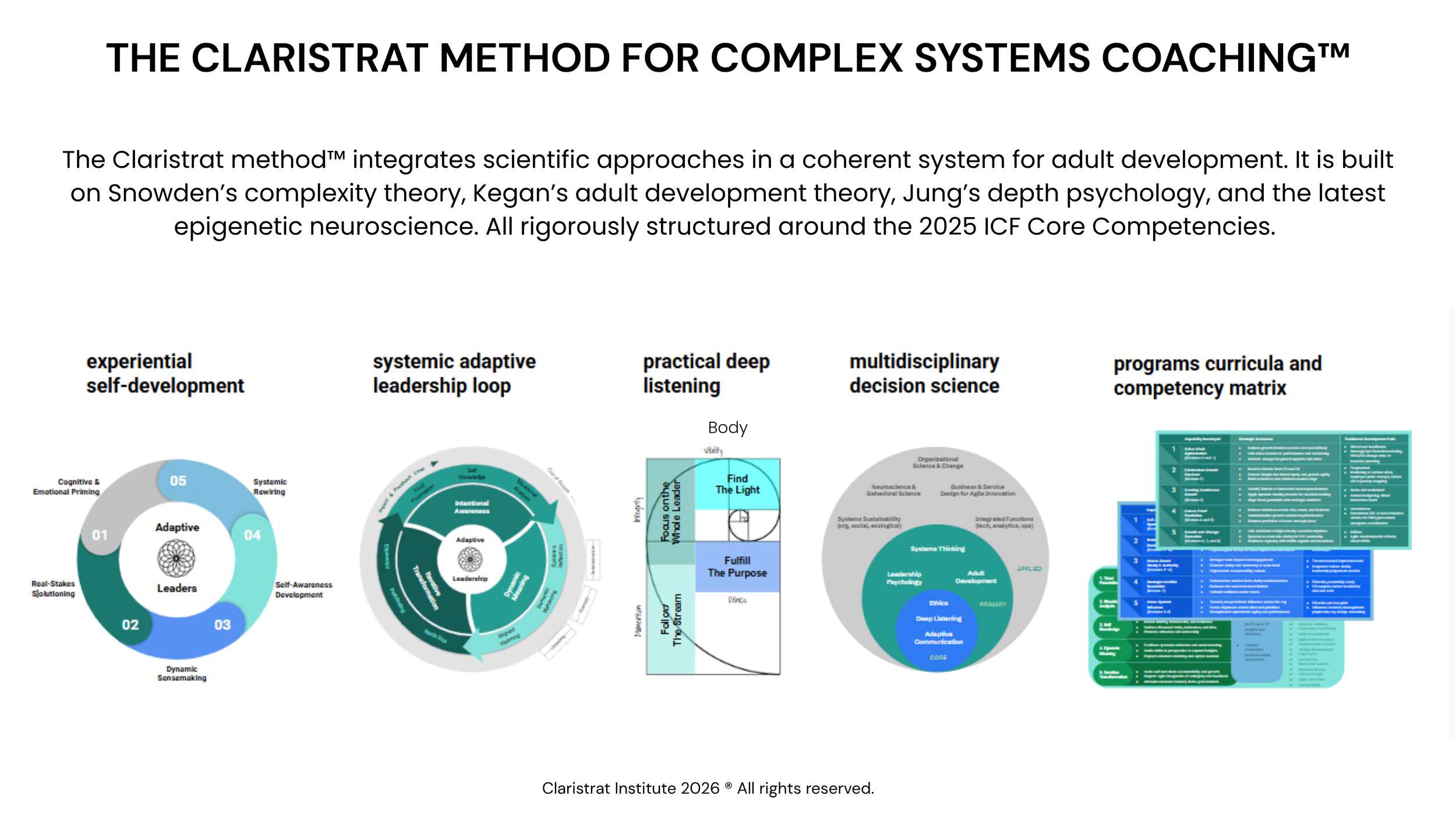
An overview of the several frameworks comprised by the Claristrat Method of complex systems coaching. This is my ongoing attempt to applied adult development, understood as semantic Self emergence.
The Claristrat Method holds both questions simultaneously because the leader and the organization are coached as one complex system. The Claripath phases are sequential and non-reversible in the developmental sense: you cannot, neurologically, engage in generative Pathfinding before establishing a Trust Foundation. But what emerges within each phase is not prescribed. The North Star that arises in Aligned Visioning is not specified in advance. It is made available by the prior developmental work and actualizes through the emergent dynamics of the specific coach-client coupling. Development and emergence are not alternative logics. At their most productive, they are two complementary ways of describing of the same process.
The design hypothesis Anne is reaching toward, a field-based instrument that surfaces patterns of meaning-making without ranking individuals against a developmental hierarchy, is viable and important. But before the instrument can work at the depth where the change actually occurs, the interior map has to be part of the foundation. The field is generated by the psychic configurations of the people inside it. A map of the field that cannot see those configurations is mapping the surface of a phenomenon whose organizing dynamics are invisible to its instruments.
The only virtue in a complex system
Dave Snowden writes: "It is a lot easier to achieve change if the system is predisposed to change. If the energy cost of virtue is lower than that of sin, then virtue is more likely."
Virtue and sin are moral categories that imply a normative hierarchy and a teleological destination which theology, as a complexity thinker, I reject. In a complex system, what persists is not sinful. It is stable. The practitioner who frames their work as reducing the energy cost of virtue has appointed themselves the moral authority of the system's attractor landscape. That is the Augustinian posture stated in complexity vocabulary. Sorry, Dave.
Jung's framework replaces this binary with something ecologically precise. What persists despite its costs is not moral failure. It is the shadow operating outside conscious mediation: unintegrated energy draining the system through the chronic leak of suppression and projection. What looks like virtue is not the absence of shadow but its conscious integration. The persona is not good. It is the defended surface that maintains the split.
In the complex system of the human psyche in its relationship with the cosmos, the only genuine virtue is ecological balance. Not moral rectitude. Not developmental achievement. Ecological balance between the psyche and the larger system it is inside: the body, the relational field, the organization, the culture, the natural world. Sin is ecological imbalance. Virtue is its restoration.
This reframes the performative contradiction Anne correctly identifies. The reason developmental ranking destroys the field is not only that it triggers threat responses. It is that it introduces ecological imbalance into the relational field: a hierarchy of judgment that splits the field into assessors and assessed, valued and deficient, advanced and behind. That split is the shadow-persona dynamic operating at the organizational level. It is ecologically costly. The observation does not produce the split. The Augustinian posture does.
And this is the overfocus on cognition making itself visible. The Western Christian inheritance, from which both Snowden and Caspari's framework draws without fully acknowledging it, treats transformation as a change in what the person knows, chooses, or reasons toward. Augustine, Pelagius, and Maximus the Confessor are all concerned with the relationship between the human and the divine as a matter of will and intellect. The body remains outside the epistemological map: the site of temptation, not the vehicle of transformation. Plato's roots poke out of the ground and make the complexity thinker trip down.
Jung broke from this inheritance deliberately. The complex is an embodied attractor with physiological correlates. The transcendent function is felt before it is understood. Porges confirms what Jung mapped clinically: the body is the primary instrument through which the encounter with the larger system is registered and integrated. A field-based instrument that cannot see what the body is doing in the encounter, that cannot see the autonomic activation that determines whether the field opens or contracts, that cannot reach the somatic attractor that will reconstitute the old pattern the moment pressure is removed, is mapping the surface and calling it the territory.
The tradition has not moved as far from Augustine as it believes. The precise term Jung would use is projection.
The invitation
Anne Caspari's article is the most serious engagement with the development-emergence distinction I have encountered in the complexity field. Her design hypothesis deserves the deepest possible foundation before it is built. The three problems she identifies, the category error, the structural fallacy, and the performative contradiction, are real. The solution she reaches toward, a field-based instrument that surfaces patterns without ranking individuals, is the right direction.
What it needs is the equally rigorous interior map. Not as a replacement for field-based observation. As the missing dimension of it without which the field cannot be seen at the depth of field where the psychosomatic change actually occurs.
In March I reached out to Dave Snowden directly. We spoke in April. I asked him to apply the Cynefin framework to the Claristrat Method as a stress test, to find where the architecture does not hold. I am still waiting for that conversation and I hope I have earned some points towards it.
To Anne directly: thank you for the surface of contact for my points in your article. There were so many. I also agree with a lot of what you said. I know you haven't asked for a polemic, but you did publish a highly problematic article which affiliation with a respected theoretician doesn't immunize from scrutiny. I look forward to your retorts, if you are so inclined.
Fabiana Pereira Hotz, PCC, is the founder of Claristrat Institute.
The Claristrat Method draws on Dave Snowden's Cynefin framework for understanding emergence in complex systems, Jung's analytical psychology for the semantic-energetic attractors that organize interior life, Kegan's adult development theory for how those attractors emerge into recognizable orders of mind in social contexts, and neuroscience for the biological underpinning of complexity dynamics and the psychosomatic conditions required for mindset change.
The institute develops the Complex Systems Coaching™ certification for senior executives and the Complex Systems Leadership Development™ methodology for senior leaders and their teams.