What an Executive Coaching Career (Really) Looks Like - Income Ramp and All
The career outcomes after executive coaching certification, reported with more transparency than the field is usually ready to offer.

Photo by Karola
It’s a Tuesday morning in March, in a newly renovated kitchen
The most prized room in the Victorian house paid off about three years ago. On the oak wood island, Rebecca Griffith leans with a notebook and does some math. (Her name is anonymized, her the story is very real.) Griffith is 56 years old and recently chose to leave a chief marketing officer role at a Fortune 1000 healthcare company. Her resume includes thirty years in corporate strategy and two grown children (one of whom just got engaged). She walked away corporate life right after her last quarterly bonus the previous month. She had a runway, conservatively calculated, of about five years before dipping into retirement savings. Across that runway she wanted to build something that could stretch that covered period for a decade or more. Something that spoke to her desire to give back and keep active in the workplace, in her terms. The something she had decided to build was not another corporate role. “I’m done” - she answered when an old friend, chairman at a competitor’s board, asked if she’d consider joining.
What Griffith is now building, technically, is an executive coaching practice. She had enrolled the previous fall in a painstakingly chosen certification program. She even told friends at dinner parties, perhaps a little defensively, that she was now "learning coaching." What she had not yet told them, because she had not realized it for herself, was that that first coaching credential was more of a new door than a new role destination.
The practice that would open on the other side would also include the two exciting advisory retainers she would work toward for six months, the paid board seat she would be offered after saying no to her chairman friend’s CMO opportunity, the speaking work that would start to emerge from the writing she was more and more engaged with (as a means of straightening her thoughts and fighting AI-brain mush), besides a dozen other gigs and crafts she could not yet see. What Griffith was building, though she did not have the word for it that morning, nor the evening before at the last social function, was a portfolio career. Her path is, however, not unusual. It is, increasingly, the prototype.
The marketing materials of executive coaching certification programs rarely commit to business specifics. You will find references to six-figure practices and premium fees with C-suite clients, but the actual structure of a senior coaching career — what you do in a week, who hires you, how the income builds, how it integrates with the advisory and board work senior leaders typically build alongside it — is generally left for you to discover after enrollment. This is only partly because the answer varies. It is also, more honestly, because the answer is more complicated than a marketing page can carry cleanly, and commercial institutions don’t usually have the editorial culture to hold this type of complication in public. What follows is an attempt at tackling this, based on my personal experience as the CEO of the Claristrat Institute and that of several of our alumni and colleagues, fellow executive coaches such as Griffith.
Executive coaching is rarely the whole portfolio
The first thing to understand is that for senior leaders, executive coaching is not a corporate role replacement. Mostly because they don’t want a full 1:1 replacement of their last decades in corporate. It’s another way to engage with the network built in their corporate life. Coaching as a second career functions as a keystone in a larger portfolio practice that typically includes welcome advisory retainers, board roles, and consulting engagements. Also, increasingly and for those so inclined, some combination of speaking, writing, or teaching. The data on this phenomenon is now reasonably well established. According to the 15th Annual MBO Partners State of Independence Report the numbers for top-tier earners tell a story of intentional diversification. The reports see a 19% increase in top earners among independent professionals from 2024 and a staggering 86% growth since 2020. Among senior executives specifically, the portfolio model is one of the propellers of the statistics, as more exiting executives learn about and adopt the model.
The question for a senior leader considering whether investing on a executive coaching certification will make sense for them is not whether coaching will replace their salary, but how. The question is how coaching, strategically placed as part of a deliberate portfolio, is worth building as a synergistic pillar. For most senior leaders who arrive at this question, the answer is yes.
What the certification actually buys you across a portfolio
A senior leader who completes a serious certification program gains four levers that compound across their portfolio rather than sitting solely within their coaching engagements. This part of the calculation is the hardest to appraise from the outside.
The abilities achieved through a rigorous executive coaching program are exactly those that distinguish a sought-after senior advisor from the moderately competent dime in a dozen. This is because successful corporate careers don’t necessarily prime executives for undivided listening across multiple registers of communication, the precision of disinterested inquiry, the management (without shutdown) of their self-interested reactions in high-stakes conversations. Not even, quite often, for the structural systemic reading and intervention in increasingly more) disrupted organizational systems.
The certified coach who also advises listens differently. Asks differently. Creates higher trust as well as the conditions under which advisory clients arrive at transformational insights themselves rather than receiving recommendations they may or may not absorb. For this reason, senior advisors with executive coaching chops report that their advisory engagements deepen, retain better, and hence can command higher fees.
Board work changes too. A board member who can sense the unspoken in a room, hold space for difficult conversations between fellow directors, and intervene with calibrated questions rather than positional statements is structurally different from one trained only in the technical content of governance. According to the 2025 Private Company Board Compensation Survey, board members report holding an average of four in-person meetings and two virtual meetings per year, with over 33% of respondents spending 50-100 hours on board work annually and another 21% spending more than this. Across that many hours, in rooms that consequential, the difference in effectiveness between a board member with coaching capability and one without starts compounding.
The credential, of course, also carries weight with organizational buyers. ICF credentials at the PCC level, and the integrated PCC plus AATC pathway, are increasingly required by corporate procurement for coaching engagements. They also improve the credibility of advisory and consulting proposals, particularly with HR-led buyers and with boards that have invested in coaching as part of their leadership development infrastructure. The credential is not the practice, but it opens and legitimizes conversations that prior career capital alone may not, particularly with Gen X and Millennial CHROs and L&D leaders who have come up in environments where ICF credentialing is the assumed professional baseline.
The last lever is the least obvious and the most consequential. The methodology of a leading edge certification — including aspects such as applied adult development, complexity-informed decision-making, and depth psychology — upgrades the informal mental models a senior leader has relied upon for decades with a highly effective diagnostic and operative framework that operates across coaching, advisory, board, and consulting work. The senior practitioner who has done this work brings a different type of flexible mind to every conversation. Clients notice this in ways they cannot articulate but reliably remunerate. The practice deepens, fees rise and referrals arrive from people the practitioner did not know they had impressed several months or years before.
The five structural pathways or senior coach advisors
After certification, you will typically operate inside one or more of five structural arrangements. Most established practitioners operate in two or three simultaneously, in some combination that suits their lifestyle and financial goals.
The independent solo coaching practice
This is what most people imagine when they think of a successful executive coach. You build your own client base, set your own fees, own your time entirely. Executive coaching at the senior end can range between $300 to $1,000 USD or more per session depending on track record, with most established coaches charging between $450 to $600 and monthly retainers ranging from $1,500 to $5,000 depending on experience and scope. At the higher band, coaches often bring former C-suite experience and may incorporate organizational assessment work. Mature solo practices at the senior end typically run ten to fifteen active clients at $750 to $1,200 per session, with annual coaching revenue ranging from $250,000 to $500,000.
The advisory or fractional practice
This is where many senior leaders combine their pre-coaching expertise with their new capability. They provide ongoing strategic counsel to CEOs, founders, and senior teams without the formal boundaries of a coaching relationship. Advisory compensation varies widely. Mid-stage and growth companies typically offer monthly retainers of $2,000 to $10,000 or annual retainers of $25,000 to $100,000, depending on responsibilities. Coaching certification does not replace advisory expertise. It sharpens the advisor's capacity to read what the client actually needs, versus what they say they need, which, in advisory work, is most of the difference between an engagement that lasts three months and a long term partnership extending over the years.
Paid board roles
These bring something else again. The compensation is meaningful — according to executive compensation consulting firm FW Cook, the average annual compensation for directors of small and midcap companies, including retainer, stock options, and meeting fees, is approximately $175,834. Larger and public companies pay considerably more. The board role brings capital and credibility. The coaching capability brings the ability to operate well inside the board itself, which is a separate thing entirely. Most directors are not trained in the kind of room-reading that boardrooms quietly require. The director who is trained in it gets re-elected.
Corporate retainers and team coaching engagements
Those occupy the fourth pathway. Senior coaches often hold one or two ongoing retainers: coaching for a specific executive team, advisory access for a CEO, a fixed monthly allocation of coaching hours for designated leaders. Team coaching engagements, which require the AATC pathway and the ACTC credential, are higher-priced than individual coaching on a per-session basis and are increasingly the format organizational buyers request when they procure coaching at the senior level. The integrated PCC plus AATC credential is what makes this work accessible without further enrollment elsewhere. This is a structural advantage worth pausing on, because most senior coaches who try to assemble it after the fact discover that adding team coaching to a PCC-only credential typically requires another twelve to eighteen months of additional training at a separate institution.
Faculty, supervision, speaking, and writing activities
This fifth pathway is the one most career-change marketing skips. The senior practitioners operating at the highest fee bands almost all maintain some combination of book authorship, conference speaking, faculty roles in certification programs, and consistent published writing. These activities rarely produce primary income. They generate something else: the visibility and intellectual community that drives referral flow into the rest of the practice. They also give the practitioner ongoing development that direct client work alone does not provide. By year ten, most senior practitioners will tell you that the writing and teaching work has become the part of the practice they would protect last, even though it pays the least.
Most senior practitioners operate across three or four of these structures over the course of their portfolio career. The classic pattern looks something like this: build coaching capability and credentials in years one through three while continuing some form of consulting or fractional work that bridges income; add team coaching capability and corporate retainers in years three through five as the credential and the network mature; layer in board roles and advisory retainers as the practice stabilizes; and gradually shift toward more institutional work — teaching, mentoring, and supervision — in the later years when intellectual contribution becomes the priority over volume.
What’s a typical work week for a senior coach advisor
There is a lifestyle question senior leaders ask a beat later in the consideration process, once financial prospects have been addressed: how can I expect my life to really look like if I go ahead with this? Based on conversations I’ve had with several active portfolio career professionals over the years, a typical week for an established practitioner with a combined coaching, advisory, and board practice looks roughly like the following.
Four to six individual coaching sessions, reaching 8 to 10 if 1:1 coaching is prioritized in the portfolio. Most sessions run 60 to 75 minutes, with the occasional one reaching 90 minutes. The practitioner reviews notes from the previous session for ten minutes before the call, holds the session, captures observations afterward. Eight sessions per week, with preparation and write-up, runs fifteen to twenty hours of focused work.
One team coaching engagement running concurrently, or one advisory retainer with a CEO or executive team. A team engagement typically meets every two to four weeks for half-day sessions, with preparation and stakeholder calls between. An advisory retainer typically involves two to four hours per week of structured contact plus reactive availability. Either commitment runs in total about three to five hours per week.
Board work distributed across the year. Private company board members average four in-person meetings and two virtual meetings per year, with most directors spending 50 to 100 hours on board work annually plus committee time. A practitioner holding one to two board seats commits roughly two to four hours per week on average across the year, weighted heavily into the weeks containing scheduled meetings.
Three to five hours of business development. At the senior end this is very rarely cold outreach. It is responsive work to inbound interest, conversations with connections that could become potential clients or referrers, written follow-up after introductions, the maintenance of the professional network that generates senior introductions.
Two hours of supervision and continuing development. Senior practitioners typically maintain ongoing supervision relationships with one or two more senior practitioners, plus participation in peer supervision groups. The hours sound small. The compounding effect over years of practice is what produces senior capability rather than mid-career stasis.
Three to six hours of writing, reading, or institutional contribution. The senior practitioners operating at the highest fee bands almost all maintain some kind of intellectual practice. Reading is also part of the work in a way it is not in most corporate roles: the senior practitioner is expected to be intellectually current with the fields the work draws on: psychology, complexity theory, organizational research, leadership literature.
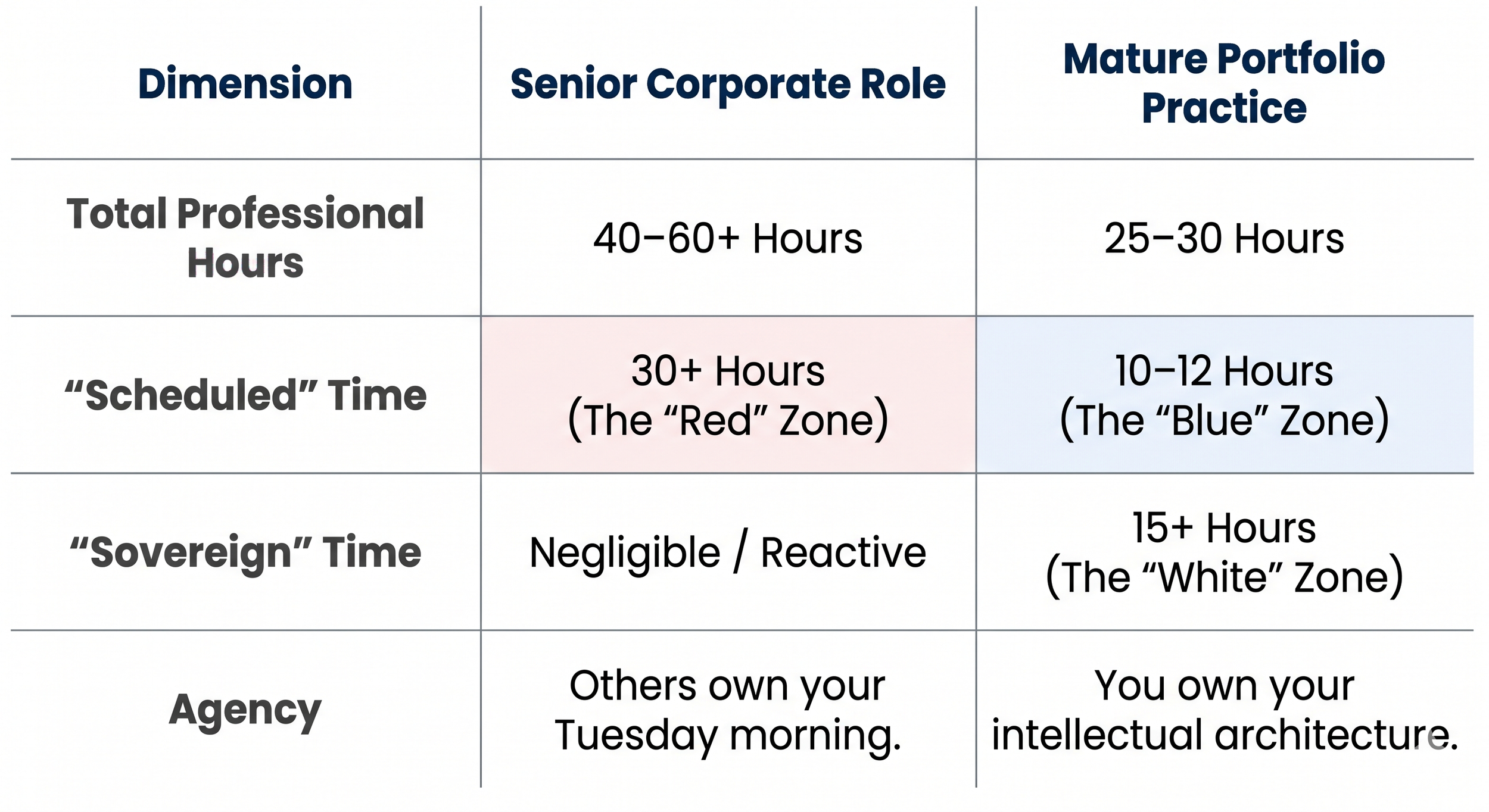
The total week typically lands at 25 to 30 hours of professional work, going up to approximately 45 hours in the weeks your boards convene each quarter. Meaningfully less taxing than a full time executive role, and distributed differently.
Most practices concentrate into three or four intentionally more concentrated days with one or two much less structured ones, including protected mornings for writing and supervision work, which over time sustain the quality of the practice. The schedule feels unfamiliar to someone arriving from a corporate calendar full of meetings, and most senior practitioners eventually consider it one of the major returns on the career change.
The texture of this routine is also different. Coaching is deep, sustained, single-thread attention to one person at a time. Senior leaders arriving from environments of constant context-switching often find the first six months of rebuilding their focus at once revitalizing and tiring in ways they did not anticipate. The fatigue subsides as the deep listening capacity builds. The psychological intensity of the work does not subside, but becomes instead a source of continuous inspiration. It is among the more demanding and yet rewarding professional formats most senior leaders will have practiced. It will suit some very much and, for virtually all, become a highly-prized capacity they will leverage with respectful balance.
Those who have transitioned report a specific kind of relief achieved through wider ownership of their time utilization. For the executive, the most profound ROI of a portfolio career isn’t found in the revenue, which we have already established is not dismissible, but in this fundamental restructuring of the clock and the texture of time.
The realistic income curve
A portfolio coaching career does not have the jumpstarted, linear income trajectory of corporate employment. It has a curve that takes deliberation to develop and reaches higher when it does. The senior leader weighing certification wants to understand both halves of this honestly, because the it’s easy to underestimate how portfolio practice building differs from being hired by a single full-time client as an employee.
The first 18 to 24 months
If you haven’t started positioning before you leave your corporate job, the beginning of this new phase can be the lowest-income period of the entire portfolio career. New practitioner will be at once building a paid client base, refining fee positioning, accumulating supervised hours required for credential progression, and discovering what the practice (and your lifestyle) will tend towards based on your goals and preferences. Annual revenue in this period — for a practitioner not bridging with consulting, advisory, or factional work — can sit between $40,000 and $90,000. This is the real entry and opportunity cost, which most senior career switchers think mistakenly they should go entirely without paying. It is also mostly why failed career transitions abort. The income gap creates pressure, the pressure hits the former executive’s self-imagem, and thus compromises the developmental work the practice requires. The practitioner ends up taking on lower-tier work to fill the gap, which lowers their reputational pull and sets the practice's market position lower than it should be for years afterward. They close the loop by securing a last full time corporate role. Not the worst outcome, as the coaching skillsets will likely help tem cruise the return in a more effective way, but their ego may feel sore for a while.
The financial preparation for this period is important than the certification choice itself. Senior leaders who make this transition successfully typically do one of three things. Some bridge with pre-arranged consulting, advisory, or board work that uses their prior expertise while the coaching practice builds. Some negotiate a phased corporate departure, reducing to part-time or fractional work for the first two years while certification and early practice run in parallel. Some accept the income trough and build a financial runway of two to three years of expenses before they leave their corporate role. The strategy that works te best depends on the specific situation. What does not work is underestimating how long the early period takes and arriving at year two unprepared for the financial pressure.
Years three through five
This is the inflection. By this stage, the practitioner has accumulated enough experience and reputation to charge near-senior fees, has built a referral network that generates inbound work, has established credentials that organizational buyers require, and is typically running a portfolio that includes coaching plus advisory plus emerging board roles. Annual revenue in this period typically reaches $200,000 to $400,000 across the portfolio, with the higher end driven by advisory retainers and board fees that are not coaching dependent, but coaching skill beneficiaries.
Years six and beyond
This is when mature portfolio practices reach their full shape. Established practitioners with strong specialization, solid referral networks, multiple credentialed pathways, and a portfolio combining direct practice with board roles and institutional work commonly operate at $500,000 to $800,000 in annual income. The top decile of senior practitioners — those with significant institutional brand, board roles at larger or public companies, and specialized practice in high-fee areas like CEO coaching or M&A leadership transitions — operate practices generating over a million annually, frequently while delivering tangible work four days per week, that is, excluding continuous social and self development.
The full arc, in sum: the early years pay less than the corporate role, the inflection comes around year three, and the mature portfolio in years six through fifteen typically reaches or exceeds the corporate compensation it replaced, often substantially. The senior leaders who make this transition successfully do so with eyes open to the early-years cost and perseverant understanding of the longer arc they are transitioning through.
What Rebecca found
Two and a half years after that Tuesday morning at the kitchen table, Rebecca Griffith had a portfolio practice she had not been able to imagine when she started. She had three coaching clients at $1,500 per session. Two advisory retainers from the network she had carried out of her corporate years, generating about $9,000 a month combined. The board seat she had been offered a few weeks after retirement, plus a second one that arrived in her eighteenth month. A regular column in a marketing trade publication that paid almost nothing and produced more inbound business than anything else she had built. A faculty role at the institute where she had been certified, which contributed modestly to her income and substantially to her professional life.
Her annual income, in year three, was running ahead of her former CMO base, and her week was eight hours shorter than it had been at her single corporate employer. She still woke up at six-thirty AM most mornings, but for different reasons, and she stopped most days before five. She had read more books in those two and a half years than in the previous decade.
What she would tell you, if you asked, was that the early year had been harder than she expected. The first six months had been almost entirely uncompensated. She had questioned the decision a few times. Once, in October of that first year, she had updated her LinkedIn discreetly to see what corporate roles were available, and found herself relieved when nothing she wanted came back.
She would also tell you that she was, on her best days, doing the work that she had wanted to be doing for the last decade of her corporate career, and could not. The work had a depth her CMO role had never quite afforded — too many meetings, too many quarters, too much of the wrong kind of urgency. The portfolio practice was not less demanding. It was more demanding in different ways. But the demands were the right ones, so they felt exciting.
The decision was real and it deserved a real weighing. Most senior leaders who make this transition with realistic expectations and an intact network find, on the other side, what Griffith found. Some do not. The early years are harder than the marketing implies and the mature practice is better than the marketing implies, and the gap between the two is what most career switchers have to be honest with themselves about before they begin.
If you are weighing this decision now, the question is whether the early-years cost should be worth what you arrive at year three. There is no abstract right answer to that question. There is only your own answer, which depends on your financial situation, your network, your tolerance for the early uncertainty, and most of all on whether the work itself — the close attention to other people's developmental edges, the discipline of presence under pressure, the privilege of being trusted with senior leaders' real material — is the kind of work you want your next chapter to be.
Griffith, sitting at her kitchen table on that Tuesday morning in March, did not know the answer yet. By the time she did, the practice she built had answered the question for her.
Further resources: If this article helped you, you might also want to investigate What You Actually Learn in an Executive Coaching Certification.