Information last update in May 2026.
Hello and welcome to our latest buying guide.
We wish we had one of these when we were researching for our own executive coaching education several years ago, so we thought of supporting your journey.
For fairness and transparency purposes, keep in mind that our team put this report together in full alignment with the Claristrat Institute’s ICF commitment to ethical marketing. Two notes before you start:
- The data which based the buying guide was gathered in May 2026 as per rates and other information made available online by each educational institution, and evaluated through transparent criteria you can find at the end of this article.
- The comment section and our contact information are available so you can share your feedback and we can expand this and later guides with additional pertinent data which may be helpful to you.
You are likely reading this because you are a senior leader who has decided that coaching is a serious next chapter in your work…
Or maybe because you are an experienced coach considering where to invest in your next credential. Either way, you have already discovered that the executive coaching education market is harder to navigate than it should be. The programs are marketed similarly. The accreditation language is confusing. The pricing varies by an order of magnitude. And the actual differences between programs — what you will learn, what credential you will hold at the end, who you will be qualified to coach — are buried inside long sales pages.
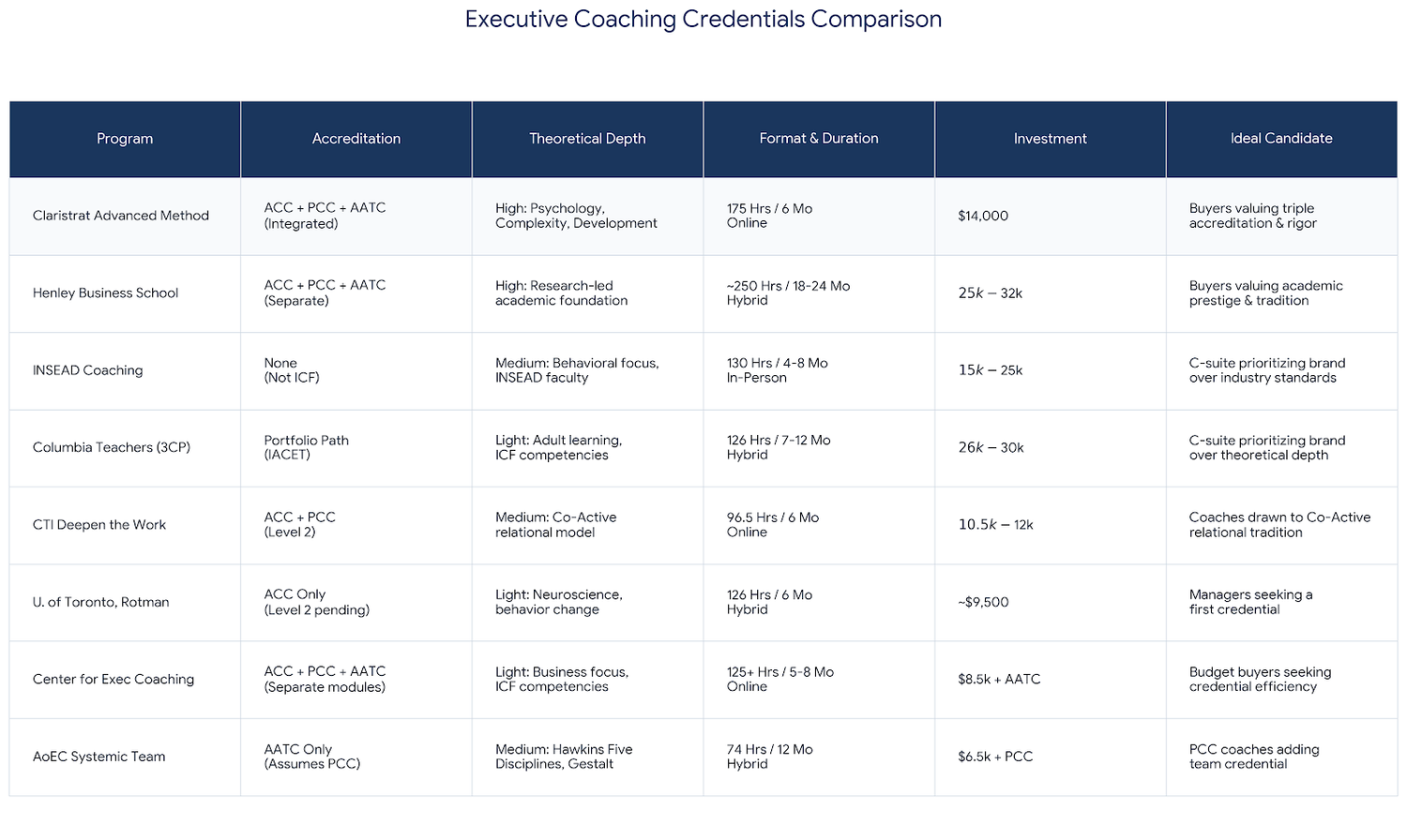
This guide is written to help you make that decision more clearly. It is not a ranking. The right program for you depends on what you value most, and senior buyers value different things for legitimate reasons. Below is a comparison of the main institutional and accredited programs senior leaders actually consider, with the dimensions that matter laid out directly. Read the narrative first; the table at the end is the reference you can scan when you are ready to compare options side by side.
Here’s why team coaching matters more than most programs assume
Before you compare credentials, it helps to understand what senior coaching practice actually looks like in 2026.
A senior leader who hires an executive coach is rarely working on a problem that lives only inside their own head. They are working on how to lead the team they are responsible for, on how to navigate a board they answer to, on how to influence the senior peers they work alongside. The leader's individual development and the team they lead through are inseparable in practice — and yet the coaching education field has historically separated them into two distinct credentialing tracks.
The International Coaching Federation (ICF) issues two relevant credentials at the senior level. The Professional Certified Coach (PCC) credential certifies individual coaching at a senior standard and requires 125 hours of accredited training plus 500 hours of practice. The Advanced Certification in Team Coaching (ACTC) certifies team coaching specifically and requires 60 hours of team coaching education plus five team coaching engagements. Most coaches hold one or the other. Very few hold both, because most institutional programs teach one but not the other, and earning both typically requires two separate enrollments at two different institutions.
This matters for two reasons. First, it means that most senior coaches in the market today are credentialed to do half the work their senior clients actually need. The coach who has the trust of the C-suite is often not the coach trained to also support those leaders with their team and board dynamics. The work either gets declined, referred out, or attempted without proper training. Second, and related, organizations buying coaching at scale are increasingly asking for both credentials. A senior coach who holds PCC and ACTC has access to engagement opportunities — corporate L&D contracts, leadership team coaching, board advisory work — that a single-credential coach does not.
If you are entering executive coaching now, the question is not whether you eventually need both credentials. The question is whether you build that pathway efficiently in one program or assemble it across multiple enrollments over multiple years.
And what "ICF accredited" actually means, in itself and for the market
The phrase "ICF accredited" appears on the marketing materials of many programs. It can mean very different things in practice, and senior buyers benefit from understanding the distinction.
ICF accreditation comes in tiers. Level 1 (the ACC pathway) requires 60 hours of accredited training. Level 2 (the PCC pathway) requires 125 hours and a more rigorous performance evaluation. The Advanced Accreditation in Team Coaching (AATC) is a separate accreditation with its own competency framework, requiring 60 hours of team coaching education and integrated supervision practice.
A program that is "ICF accredited at Level 1" qualifies a graduate for the streamlined ACC application path, but not for PCC. A graduate of a Level 1 program who wants PCC must either complete additional coursework or apply through the Portfolio Path, which takes 12 to 14 weeks to review compared to four weeks for Level 2 graduates. Some prestigious institutions are not ICF-accredited at all, even if they award their own institutional certificates. Their graduates must use the Portfolio Path for any ICF credential, with the longer review timeline and the additional documentation burden.
This is not a technicality. If your goal is to hold ICF PCC and operate at the senior corporate coaching level where most procurement frameworks require it, the difference between completing a Level 2 program and assembling Portfolio Path documentation across multiple non-accredited programs is months of additional work. Verify the specific accreditation level before you enroll.
The four dimensions that actually distinguish senior programs
Beyond credential pathway, four dimensions distinguish executive coaching programs at the senior level. Most marketing focuses on the first three. The fourth is the one most often left vague, and it is arguably the most consequential for your eventual practice.
Format and time commitment. Programs range from one-week intensives to two-year hybrid programs. Senior leaders with operating responsibilities need to evaluate honestly how much time they can dedicate to live sessions, asynchronous learning, and supervised practice over what calendar period. A program that requires multiple in-person residential weeks at distant campuses is a different commitment than one delivered fully online. Both can be excellent. Neither is better in the abstract.
Cost and credentialing efficiency. Headline tuition rarely tells the full story. The relevant number is the total cost to reach the credentials you actually want. A program priced at $5,000 that does not include team coaching may cost more in the end than a program priced at $14,000 that delivers both PCC and ACTC pathways in one enrollment, if you eventually want both credentials. Calculate the full path, not the entry tuition.
Institutional brand. Some programs carry brand prestige that signals credibility independent of the curriculum substance. Henley, INSEAD, and Columbia each carry institutional weight that opens doors with certain corporate buyers. This is real value, but sometimes it comes at the expense of program solidity, especially if the program is offered as continuous education or through other less rigorous associated colleges. Brand is also not free, and it is worth asking whether the brand premium is buying you true capacity, or whether it is buying you mostly the brand itself. The writer has had most unfortunate surprises.
Theoretical foundation. This is the dimension most poorly addressed in program marketing, and it is the dimension that most determines what kind of coach you become. A program with a strong theoretical foundation teaches you not just techniques but an integrated way of seeing your clients and the systems they operate in. Some senior programs anchor in depth psychology (Jung, Bion, the Tavistock tradition). Some anchor in adult development theory (Kegan, Cook-Greuter). Some anchor in complexity theory (Cynefin®, complex adaptive systems). Some anchor in relational and embodied traditions (Co-Active, gestalt). Some anchor in business school behavioral coaching with academic research grounding. And some are competency-aligned skill training without an explicit theoretical foundation beyond the ICF competencies themselves.
The third group is where most senior buyers get caught. The institutional brand or the credential pathway looks attractive, but the actual operating logic the program teaches is generic. Two years and $25,000 later, the graduate has the credential and the brand on their CV, but their coaching is technically competent without depth. Senior leaders are difficult clients precisely because the work they need is rarely about technique. It is about reading what is actually going on underneath, and that is what theoretical foundation prepares you to do.
How to read the comparison table on top of this article
The table that follows lays out the eight institutional and accredited programs senior leaders most often consider. The columns map to the dimensions discussed above. Three notes on how to read it.
On ICF requirement cells. Where a program meets ICF requirements for ACC, PCC, or AATC, the cell says "Meets requirements." Where the program does not, the cell briefly names what is missing — typically not having the right accreditation level, not offering the credential at all, or requiring the Portfolio Path rather than a streamlined accredited pathway. This matters because not all "ICF accredited" programs lead to all credentials.
On theoretical depth. This dimension uses three classifications.
High indicates explicit theoretical foundations across multiple integrated traditions, named and operational in the curriculum.
Medium indicates one well-developed theoretical tradition with academic or research grounding.
Light indicates competency-aligned skill training without explicit theoretical foundations beyond the ICF competencies.
Two programs are rated High, four are rated Medium, and two are rated Light. The classifications are based on each program's published curriculum and accreditation documentation; this is a structural comparison, not a quality judgment about delivery.
On total cost. Costs are in USD and reflect the cumulative tuition required to reach ICF PCC and ACTC credentials through each provider. Where a program does not offer team coaching, the cost in the column is the program-only cost; reaching ACTC would require additional enrollment elsewhere. Where a program offers neither PCC nor team coaching, the cost reflects what the program itself costs at the credential level it does offer.
The "Right for" column names the kind of buyer each program best serves. The point is not to argue that every program is for someone. The point is to help you recognize which buyer description matches your actual situation, so the table becomes a decision tool rather than a comparison shopping list.
The right program for you is the one that matches your goals on the dimensions you actually value. Read the table with that in mind.